Roof Repair or Replacement? The Questions Worth Asking First
A stain on the ceiling doesn't tell you whether you need a patch or a new roof. What's underneath the shingles usually does.
September 10, 2026 · 4 min read
Most roof problems announce themselves the same way, a stain, a missing shingle, a soft spot near a vent. What that means for the roof underneath can be very different depending on the age of the roof, how the water got in, and how much of the roof deck it's touched. That's the actual decision, repair or replace, and it's worth understanding before anyone gives you a number.
Start with the age and the layers
A roof's age matters less on its own than most people think. What matters more is how many layers are up there and what shape the roof deck is in underneath. A localized leak on a roof that's a handful of years old, with sound decking and one layer of shingles, is very often a straightforward repair. The same leak on a roof that's well past its expected life, especially if there's more than one layer of old shingles underneath, is a different conversation, because the fix that would actually hold is closer to a full tear off.
It also matters whether the problem is showing up in one spot or in several places at once. A single soft area near one vent points to a localized cause. Soft spots turning up in more than one place, or shingles curling across large sections rather than just one corner, usually means the roof as a whole is reaching the end of what a repair can reasonably fix.
Where the water actually got in
A leak rarely shows up in a ceiling directly under where the water entered the roof. Water runs along the underlayment, along a rafter, along a nail, before it finds a way through the drywall. That means a good inspection traces the path back to the source, checking flashing around chimneys and vents, valleys where two roof planes meet, and the ridge, not just patching the spot on the ceiling. A repair that only addresses where the stain showed up, and not where the water got in, tends to come back.
What a repair can and can't fix
A repair makes sense when the damage is contained, a section of flashing that's failed, a handful of shingles lifted or cracked by wind, a vent boot that's dried out and split. Those are all real, common, fixable problems on an otherwise sound roof. What a repair can't fix is a roof deck that's soft or spongy underfoot, widespread granule loss across the whole roof rather than one section, or a roof old enough that matching shingles is no longer realistic because the product line has been discontinued. At that point patching one area just moves the next failure somewhere else on the same roof.
A roof that outgrew a repair
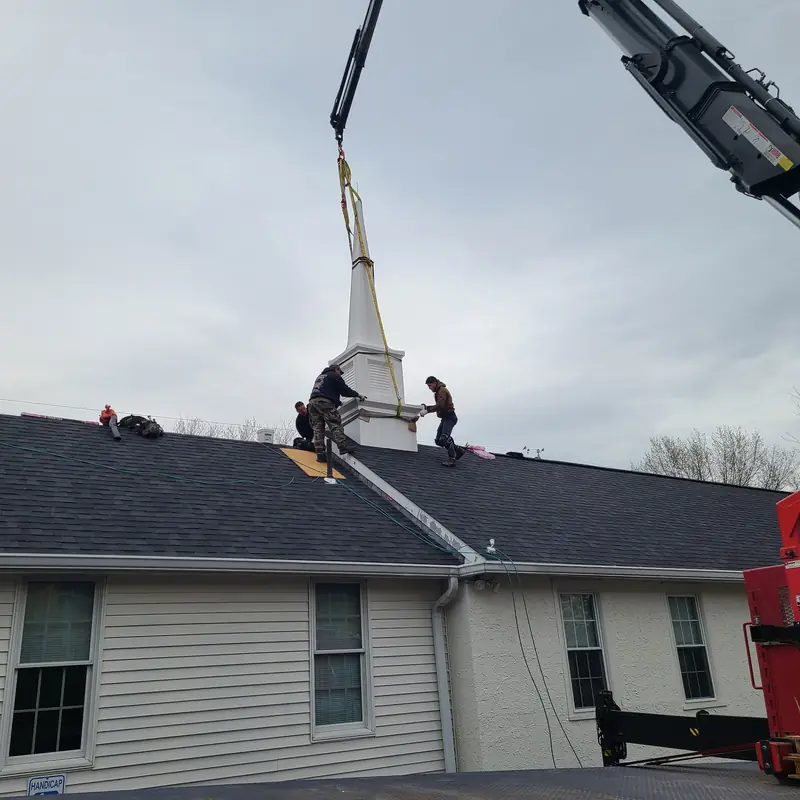
We've been the roofer for Ardsley Bible Chapel on Jenkintown Road for more than fifteen years, and their building is a good example of how a job can grow once you're actually up there. What started as roof work turned into a full reroof, and partway through, the church asked if we could also handle a new steeple on top of the finished roof. We brought in a boom truck, the crew guided the steeple down by hand while one person worked underneath to secure it in place, and we billed the extra work on a time and materials basis rather than trying to force it into the original scope. That's the kind of thing that's hard to price accurately until you're actually up on the roof and can see what you're working with.
Questions worth asking whoever quotes it
- Did they get on the roof, or quote from the ground and photos alone
- Are they describing a specific cause for the leak, or just a general area
- What's the actual condition of the decking underneath, not just the shingles on top
- How many layers of old roofing are already up there
- What happens if they find something different once the old roofing comes off
Whatever you decide, get the scope in writing before work starts, exactly what's being repaired or replaced, what happens if the crew finds something different once they're into it, and how long the work is expected to take. An estimate that's vague about scope is harder to hold anyone to once the job is underway.
Get a second look before you decide
We do free roof inspections and give straight answers about whether a repair will actually hold or whether it's time to talk about replacement. If you've had storm damage, we answer emergency calls around the clock. Call (267) 688-3163, we cover Montgomery and Bucks County including Horsham, Abington, Upper Dublin, Doylestown, and everywhere between.
Aronson Roofing and Siding, (267) 688-3163
Call (267) 688-3163More articles
What Ice Dams Actually Do to a Pennsylvania Roof
A hard freeze followed by a warm afternoon is exactly the weather that builds an ice dam at your eaves, and most homeowners don't notice until the ceiling stain shows up.
Slate and Cedar Roofs on Older Montgomery County Homes: Repair, Match, or Replace
A slate or cedar roof doesn't fail the way an asphalt roof does, and fixing one the wrong way usually costs more than doing it right the first time.